Three blogs are too many blogs. Plus there is the constant pressure
of coming up with content for all three of them that is specific to the
niche that I’ve established for each of them. Grist for the Muse:
Writing ideas and inspiration; The 15-Minute Writer – Finding time to write and time management techniques and tips for writers. And this blog: Flash Writing
– Devoted to providing content that is for writing anything less than
1000 words long. These are all very narrow focuses, and I’m finding that
I have a lot to say that exists in between these niches.
The
best writing blogs give you a glimpse into the writer’s mind and life
and lets you get to know him/her. The have good days and bad days. They
have opinions. They rant. They rave. The express their doubts and fears,
as well as their successes. But none of my blogs have that kind of
energy right now. At times I dread looking at them because I know they
are defective and diseased, but yet feel I need to nurture them even
though they are clearly rabid and need to be put down. So I’m putting
them down.
Good writing blogs are about two things: The writing life and making money with it. So the new focus of Flash Writing
moving forward: Write Fast. Make Money. I’m not promising that I won’t
change focus or change my mind on the other blogs. I will keep them
online for a while and redirect them here to this site, as well as take
the best content on them and republish it here
Flash
fiction is interesting to me, but I’m not sure that I can become a
definitive destination site for writing all things that flash. There are
other sites out there that do a much better job of this. FlashFiction.Net
for example does a great job providing resources, interviews, stories
and other articles surrounding flash fiction… But as I’ve always said,
the principles of Flash Writing can be used for any writing project, so
I’m going to build upon this concept and focus on growing one site well
instead of three sites poorly.
I have content that fits none of these niches that will be of interest to writers everywhere, so I want Flash Writing
to be that destination from now on. So go there for your time saving, productivity tips and all of the
other content you've been seeing on The Fifteen Minute Writer over the past
several years. The Fifteen Minute writing concept is one that is core to my writing practice and a book will emerge from this concept soon, so watch for it.
To head over to Flash Writing click HERE.
Friday, March 09, 2012

Wednesday, February 08, 2012
6 Things I Like About the Kindle Fire
I was reluctant to buy an eReader. I love books. I love the smell, the rasp of turning pages, looking at the colors and sizes of them on bookshelves. I’ve surrounded myself with books as look as I can remember. Going to an electronic device that would replace the physical presence of books was inconceivable to me.
I had a plethora of reasons not to convert. Before… the displays were hard to read unless you had a specific quality of light, or if it was too bright, you couldn’t use it. Furthermore, I am clumsy. If I drop a tree-based book, there’s no harm done. If I get the book wet, it is annoying, but you could always dry it out. If you lose a book, it is an inconvenience and at worst, you are stuck with the cost of replacing the book, not out $100 + dollars to replace an eReader.
But the $150 price tag for a Kindle Fire was too hard for me to resist. I bought one on the release day as a birthday present to myself. It seemed like a low-risk way to give eReaders a try and start getting in touch with one of the hottest literary trends out there now, eBooks. And I am surprised to say that I like my Kindle Fire. I like it a lot. So what do I like about it?
 |
| Courtesy of Pierre Lecourt via Flickr |
But the $150 price tag for a Kindle Fire was too hard for me to resist. I bought one on the release day as a birthday present to myself. It seemed like a low-risk way to give eReaders a try and start getting in touch with one of the hottest literary trends out there now, eBooks. And I am surprised to say that I like my Kindle Fire. I like it a lot. So what do I like about it?
- Free Books – This has to be (by far) the best thing about the Kindle Fire. Every day, Amazon (in cooperation with the authors and publishers) has literary classics available for downloading as well as a selected list of eBook versions of popular books. They may only be free for a couple of days, or somewhat longer, but there is always a variety of free books for any reading interest. Some of these books are only available on the Kindle in an eBook format, while others are free books to introduce readers to a new author or series of books. Every day Kindle lists the Top 100 Free Books. I’ve downloaded over 250 free books so far and have been happy with the quality and value of the information in most of them so far.
- Highlighting and Note Taking – For books in my personal collection, I’ve always had this obsessive need to keep them neat and unmarked. With the Kindle’s feature that allows you to take notes and highlight passages, this becomes an easy way to track important info or review your thoughts as you read through a book.
- Games – A guaranteed time waster for a writer, but I LOVE playing Words with Friends on my Kindle.
- Internet Browsing – This is pretty smooth for a portable device despite the difficulty of entering text quickly into the search or address windows.
- Netflix – With a decent wireless connection, video content is easily watchable and fun.
- Free Apps – Every day Amazon features a new application that you can download for free. Most of the offerings are free games, but some of them have been very nice commercial applications (such as Documents-to-Go). It is fun waking up each morning to see what the free app of the day is.
Tuesday, January 10, 2012
New Year's Resolutions? Meh...
This is the first year in a long time that I haven’t made any resolutions. My typical resolutions are the following:
Now granted, it helps to have SOMETHING written down and something to work towards. And considering that I’m STILL unemployed and have just a little freelance work trickling in, maybe I SHOULD make a few resolutions, but I’m trying something a bit different this year.
I’m going to create new habits and only focus on one habit at a time. This month, I’m getting addicted to writing. You heard me right. Get myself addicted to a GOOD thing. I’m going to force myself to set a timer at least once a day and just write for 15 minutes. Even if I have no idea where I’m taking it, I’m going to do it. I signed up for an online flash fiction that requires that I critique at least 4 stories a month and (suggests) that I write at least one. I have 3 blogs of which I'm trying to grow and build traffic for. I have Tweets to my (currently) 215 followers to create and find. I have an outline of a book project to work on. I have freelance work to find and produce. There is plenty of substance for this addiction.
So whether it is a freelance assignment, a blog post or creative work on one of my many incomplete projects, I’m going to force myself out of the box occasionally, ignore whatever crises seem to be on hand, and take that time to write something outside of the box. I'm going to stop being obsessed with one problem at a time. Stop retreating into distractions such as Words with Friends tournaments with my buddies, seeking the top Bejeweled Blitz score of all of my Facebook friends, or obsessive TV series watching. December featured a run of the last 3 seasons of Dr. Who on Netflix...
In addition, December had the death of a close friend, a washing machine that could not be repaired and needed to be replaced, a gas furnace that, was too expensive to repair, also needed to be replaced, and, of course, the holidays. So the 30-Day Writing Challenge was a miserable, epic FAIL.
This is always the darkest part of the year for me. After the holidays are over, here in Ohio winter usually bites down hard… with gray skies and a deep, painful cold that makes you just want to roll yourself up in quilts and hibernate until the sun comes back.
But I’m going to fight this. I have to.
So what do you do to chase away the mid-winter blues? How do you keep productive during stressful, busy times? And what are your New Year's Resolutions (if you have any)? Comment below.
- Write xxx # of words per day.
- Start an exercise program.
- Make xxxx $ in freelance income this year.
- Post 7 blog posts each week.
- Finish and publish the next book by October 1st.
- Etc...
Now granted, it helps to have SOMETHING written down and something to work towards. And considering that I’m STILL unemployed and have just a little freelance work trickling in, maybe I SHOULD make a few resolutions, but I’m trying something a bit different this year.
I’m going to create new habits and only focus on one habit at a time. This month, I’m getting addicted to writing. You heard me right. Get myself addicted to a GOOD thing. I’m going to force myself to set a timer at least once a day and just write for 15 minutes. Even if I have no idea where I’m taking it, I’m going to do it. I signed up for an online flash fiction that requires that I critique at least 4 stories a month and (suggests) that I write at least one. I have 3 blogs of which I'm trying to grow and build traffic for. I have Tweets to my (currently) 215 followers to create and find. I have an outline of a book project to work on. I have freelance work to find and produce. There is plenty of substance for this addiction.
 |
| Courtesy of Matt via Flickr |
In addition, December had the death of a close friend, a washing machine that could not be repaired and needed to be replaced, a gas furnace that, was too expensive to repair, also needed to be replaced, and, of course, the holidays. So the 30-Day Writing Challenge was a miserable, epic FAIL.
This is always the darkest part of the year for me. After the holidays are over, here in Ohio winter usually bites down hard… with gray skies and a deep, painful cold that makes you just want to roll yourself up in quilts and hibernate until the sun comes back.
But I’m going to fight this. I have to.
So what do you do to chase away the mid-winter blues? How do you keep productive during stressful, busy times? And what are your New Year's Resolutions (if you have any)? Comment below.
Sunday, December 04, 2011
Holiday Promotion Disaster
30-Day 15-Minute Writer Challenge: Day #3
Have you ever had one of those days that nothing goes according to plan? Yesterday, Kristen and I planned a quick trip to the Kroger Marketplace to spend the $130 "credit" we had earned for a special promotion. There were several problems with this:
I have never seen shelves picked so clean. Not even during the last week of a going out of business sale. The store was trashed. Discarded items tossed everywhere. The lines for checking out were stretched to the back of the store and wound around the aisles. None of the scan-it-yourself bar code scanners worked, none of the items that qualified for the credit were marked, so you had to find a harried Kroger employee with a hand scanner and ask them to scan the items for you so you could add up what you spent so far as well as determine if the item was even eligible to be used for the program.
So our modest goals of picking up a new frying pan, a couple of nifty Christmas decorations and a few board games for the kids had to be abandoned. We bought exciting things like a cake server, basting brushes, some storage containers, a clock, a couple of card games, a sock drawer organizer... etc. Nothing that could be useful to give someone else as a gift or something that we really needed, but we didn't want to waste the credit since we were already in the store.
I get it. Companies want to attract customers with special programs around the holidays. They offer special deals but also count on the power of our (the customer's) laziness to offset the cost to the company for those special deals. We forget we have the credit. We forget about the date when you can redeem that credit. We don't take the time to read the fine print and show up to redeem the credit too late. This is why stores offer mail-in rebates. The stores get to offer a great deal, but the customer has to do some work to get that deal, and a lot of us don't do that. It's a win-win for the company. They graciously offer great deals, yet only take a hit on part of the cost.
But this one was clearly an epic fail. The customers weren't happy, the employees weren't happy and really got the worst job of trying to manage this poorly planned fiasco, while the brilliant marketing executive who came up with this gimmick was probably sleeping in on this sunny Saturday morning, oblivious of the hurricane that he unleashed for the Kroger employees and managers around the state.
We spent 3 hours at a store when we planned on a quick 30 minute trip to shop for a few things on our list and take it easy the rest of the day. No one in the checkout lines was smiling. None of the employees were either.With a little foresight, planning and communication of essential information, this could have been a good experience. Kroger failed.
What should you take away from this rant? Ideas are great. Ideas are wonderful. But if the idea has no organization to support it it will die, and in extreme cases like this one, it will maim you and others along with it.
Have you ever had one of those days that nothing goes according to plan? Yesterday, Kristen and I planned a quick trip to the Kroger Marketplace to spend the $130 "credit" we had earned for a special promotion. There were several problems with this:
 |
| Courtesy of Jason Brackins via Flickr |
- The nearest Kroger Marketplace store was 30 minutes away.
- There are only about 7 Kroger Marketplace locations in the Columbus area, while the number of Kroger stores offering holiday "credit" numbers over 50. The credit was redeemable only at the Marketplace locations.
- The time to redeem your credit was limited to 4 days.
- The types of items that you could use your credit on were limited. Mainly toys, housewares, clothing (although I didn't see any clothing at this particular location), some office supplies and some cleaning supplies.
- No price tags on any of the items, so if the item was removed from the shelf where the price was listed, you had no idea how much the item was.
- A stipulation that you had to spend ALL of the credit or you'd have to pay full price for the items you bought. For example, if I bought $129.85 worth of goods, the credit was no good and I'd waste it unless I found something else last minute to push it up over the $130 mark. And none of this information was communicated in a clear, meaningful way until you entered the store.
I have never seen shelves picked so clean. Not even during the last week of a going out of business sale. The store was trashed. Discarded items tossed everywhere. The lines for checking out were stretched to the back of the store and wound around the aisles. None of the scan-it-yourself bar code scanners worked, none of the items that qualified for the credit were marked, so you had to find a harried Kroger employee with a hand scanner and ask them to scan the items for you so you could add up what you spent so far as well as determine if the item was even eligible to be used for the program.
So our modest goals of picking up a new frying pan, a couple of nifty Christmas decorations and a few board games for the kids had to be abandoned. We bought exciting things like a cake server, basting brushes, some storage containers, a clock, a couple of card games, a sock drawer organizer... etc. Nothing that could be useful to give someone else as a gift or something that we really needed, but we didn't want to waste the credit since we were already in the store.
I get it. Companies want to attract customers with special programs around the holidays. They offer special deals but also count on the power of our (the customer's) laziness to offset the cost to the company for those special deals. We forget we have the credit. We forget about the date when you can redeem that credit. We don't take the time to read the fine print and show up to redeem the credit too late. This is why stores offer mail-in rebates. The stores get to offer a great deal, but the customer has to do some work to get that deal, and a lot of us don't do that. It's a win-win for the company. They graciously offer great deals, yet only take a hit on part of the cost.
But this one was clearly an epic fail. The customers weren't happy, the employees weren't happy and really got the worst job of trying to manage this poorly planned fiasco, while the brilliant marketing executive who came up with this gimmick was probably sleeping in on this sunny Saturday morning, oblivious of the hurricane that he unleashed for the Kroger employees and managers around the state.
We spent 3 hours at a store when we planned on a quick 30 minute trip to shop for a few things on our list and take it easy the rest of the day. No one in the checkout lines was smiling. None of the employees were either.With a little foresight, planning and communication of essential information, this could have been a good experience. Kroger failed.
What should you take away from this rant? Ideas are great. Ideas are wonderful. But if the idea has no organization to support it it will die, and in extreme cases like this one, it will maim you and others along with it.
Friday, December 02, 2011
Finding 15-Minutes to Write: Batch Your Tasks
30-Day 15-Minute Writing Challenge - Day #2
I spent my initial 15-minute session generating content for my Provocative Phrase Friday writing prompts on the Grist for the Muse blog. By tackling these all at once, I generated about 3 months-worth of content for these posts. Granted they still need some edits and select the perfect provocative photo prompts to complete the posts, but the hard work is done. I spent about another 30 minutes putting together enough content to last well over 6 months.
 Batching tasks is one of the ways that you can save time by handling several closely related tasks at the same time. Some of the common ways to do this:
I spent my initial 15-minute session generating content for my Provocative Phrase Friday writing prompts on the Grist for the Muse blog. By tackling these all at once, I generated about 3 months-worth of content for these posts. Granted they still need some edits and select the perfect provocative photo prompts to complete the posts, but the hard work is done. I spent about another 30 minutes putting together enough content to last well over 6 months.
Batching tasks is one of the ways that you can save time by handling several closely related tasks at the same time. Some of the common ways to do this:- Make all of your phone calls at the same time
- Save errands in a specific part of town and do them in one trip
- Pay bills all at once at a specific time of the month
Thursday, December 01, 2011
Finding 15 Minutes to Write: Use a DVR
Post #1 in the 30-Day 15-Minute Writing Challenge
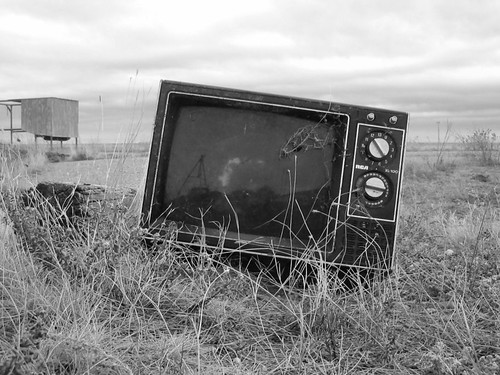
TV is one of my biggest time wasters. If a television is on and I am in the room doing something else, I will watch it. I try to avoid looking at it at all when there’s work to be done, but I still love TV. I love watching House, The Middle, The Office, The Walking Dead, Breaking Bad... you get the idea.
Luckily, I have had Tivo since the first series was manufactured over 10 years ago, and never have looked back. Since then, the rest of the world seems to have caught up with me and DVRs are common in homes now, whether purchased by the saavy consumer or provided by their local cable company.
 |
| Courtesy of the autowitch via Flickr |
What does this have to do with writing? According to Wikipedia: The average number of minutes of TV advertising for each hour of commercial television in the US is between 15 to 18 minutes per hour. But that amount seems to be similar in the rest of the world. The UK: Between 12 to 15 minutes per HALF HOUR?!? Germany: 12 to 20 minutes per hour (depending on the time of day). Argentina: 12 minutes per hour. Russia: Around 15 minutes per hour. The Philippines: A max of 18 minutes per hour.
So even if I limited myself to watching 6 hours a week of live TV, I’m wasting 90 minutes of time that could be recovered simply by using my DVR to skip through the commercials. If I watch sporting events, such as an NFL game, I’m probably wasting even more time per hour.
I rarely watch a program at the time that it originally airs. Sometimes I miss the entire series of TV shows, discovering them later on Netflix, Amazon Prime or some other video streaming service, when I have time to sit and watch several episodes in row; Like I did when I watched Joss Whedon’s incredible sci-fi/western mash-up series, Firefly when I was stuck in bed with pneumonia last Christmas.
Time is precious, so if you are going to “waste” it watching TV, use a DVR and put that recovered time to work with your writing. Tune in tomorrow for post #2 in the 30-Day 15-Minute Writing Challenge.
Tuesday, November 29, 2011
The One Thing You Must Know About Writing
This is the one thing that I just wish I could remember when I have those dark days where I lose faith in myself. Those days where I wonder why I bother doing this at all, this writing thing. Those days where I loathe myself for not getting the writing done, ensnared in resistance and full of excuses (sometimes even good ones) about why it isn’t happening.
Yes, I’m unemployed. Yes there are challenges, doctor’s appointments, band practice, sick kids and the never ending time-consuming tasks of eating, sleeping, laundry and the occasional home repair project… but everyone has them. And what they are is the sneaky way that resistance or the Inner Critic slip into your life and sabotage your efforts.
I’ve been fighting and losing the battle the last couple of months. I have good intentions, but get sidelined and manage to put off the writing for just a little while longer, or tell myself that this cover letter is the most important thing I have to do today, when, in truth, there is plenty of time for both.
Maybe I don’t like the particular project I’m working on. Maybe I’m just not in the mood to draft the copy for the sales page on my website right now, but the fact of the matter is: It is important and not having it done is preventing me from completing other tasks that depend on it.
Maybe I’m not in a mood to write a blog post, because who’s going to read it anyway… at least that is what the critic is telling me right before I open Microsoft Word and begin typing… then decide to check my Twitter feed instead.
But if I decide to sit down and set a timer and write for just 15 minutes, and vow not to check email for that period of time, act on a random thought that occurs during that time (such is the power of the web) and focus on just getting something down, I often find myself resetting that timer for another 15 minutes and then another, and soon enough, the dreaded project is done and I FEEL GREAT! Even if I only do 15-minutes, my brain lets me relax because it has checked writing off of today's must-do list.
That is the part that I always forget about. The guilt-free, anxious feeling erased from the rest of my day which allows me to enjoy watching some Walking Dead, stupid videos on YouTube, or reading for pleasure without that timer that seems to always be ticking in my head.
You are never going to feel that the time is right to write. It never happens. There is always something more important, more urgent to do. You will never feel less tired, in the mood, or more inspired than you do right now.
Make a promise to yourself to write just 15 minutes a day. Mark it on your calendar, your to-do list or put it on a post it note that you carry with you everywhere, and do it. Write for at least 15 minutes a day, during the entire month of December with no excuses and see how you feel at the end of the month.
Who's going to join me? With apologies to Tom Petty: "Sometimes the starting is the hardest part..."
Yes, I’m unemployed. Yes there are challenges, doctor’s appointments, band practice, sick kids and the never ending time-consuming tasks of eating, sleeping, laundry and the occasional home repair project… but everyone has them. And what they are is the sneaky way that resistance or the Inner Critic slip into your life and sabotage your efforts.
 |
| Courtesy of Eddie Van 3000 via Flickr |
Maybe I don’t like the particular project I’m working on. Maybe I’m just not in the mood to draft the copy for the sales page on my website right now, but the fact of the matter is: It is important and not having it done is preventing me from completing other tasks that depend on it.
Maybe I’m not in a mood to write a blog post, because who’s going to read it anyway… at least that is what the critic is telling me right before I open Microsoft Word and begin typing… then decide to check my Twitter feed instead.
But if I decide to sit down and set a timer and write for just 15 minutes, and vow not to check email for that period of time, act on a random thought that occurs during that time (such is the power of the web) and focus on just getting something down, I often find myself resetting that timer for another 15 minutes and then another, and soon enough, the dreaded project is done and I FEEL GREAT! Even if I only do 15-minutes, my brain lets me relax because it has checked writing off of today's must-do list.
That is the part that I always forget about. The guilt-free, anxious feeling erased from the rest of my day which allows me to enjoy watching some Walking Dead, stupid videos on YouTube, or reading for pleasure without that timer that seems to always be ticking in my head.
You are never going to feel that the time is right to write. It never happens. There is always something more important, more urgent to do. You will never feel less tired, in the mood, or more inspired than you do right now.
Make a promise to yourself to write just 15 minutes a day. Mark it on your calendar, your to-do list or put it on a post it note that you carry with you everywhere, and do it. Write for at least 15 minutes a day, during the entire month of December with no excuses and see how you feel at the end of the month.
Who's going to join me? With apologies to Tom Petty: "Sometimes the starting is the hardest part..."
Friday, September 23, 2011
Reading Elimination Tournament Round 1: Does Anyone Want Free Books?
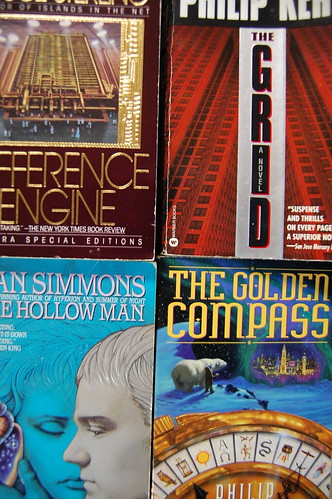 No one so far has wanted any of the books that have been eliminated. Did I scare you off? Just wondering.
 I’ve really been falling behind on these posts for the Reading Elimination Tournament, and I just need to get Round 1 finished so we can move on to analyze the survivors and keep reading. So here is the latest round of reviews.
The Golden Compass – Philip Pullman (1995)
I’ve heard about this series for quite some time and been meaning to read them, and The Golden Compass does not disappoint you. Within the first five pages we're introduced to Lyra and her daemon who looks like a moth. We also have them sneaking into a forbidden room, almost getting caught, and witnessing a possible poisoning. The otherworldly feel of this book is amplified by little details such as the daemons. I like how this book starts out in the middle of the action and with a significant event within the first five pages. It sets up some elements of the fancy world and beckons you to read more about it. On to round two.
The Grid – Philip Kerr (1995)
The Grid has an interesting premise, a high-tech office tower that is completely run by computers, yet it turns bad and starts to kill people trapped inside. What's not to like about that? However, I have to make a decision based on the first five pages, and these pages seem to be laying out a lot of background which may or may not be necessary to get the book underway. The description is okay but we still have no idea who the protagonist might be, nor any foreshadowing of what is about to happen within the story and barely any dialogue at all. Although this book slides into one of my areas of interest: technology gone stark raving mad, I'm going to have to eliminate this one based on the content of the first five pages.
The Difference Engine – William Gibson and Bruce Sterling (1991)
This book is acknowledged as one of the pillars of the steampunk genre. Within the first five pages we are introduced to Sybil, a woman who appears to be a prostitute in an alternate Victorian England. In this reality computers have existed for a while and are used to research information about anyone. Although I don't typically enjoy the Victorian era setting in stories, the map in the front of the book showing the world of this 1855 (which looks a lot different than the actual world of 1855) is interesting. I'm sure this book needs a little more time to get started, and I'm intrigued to give it a chance. Round two for this one.
The Hollow Man – Dan Simmons (1992)
Dan Simmons is one of my favorite authors. In the first five pages we meet Bremen and his wife dying of cancer. They are both telepathic. He tries to fill her last night on earth with good memories via that link. She dies around page 5. This is a great way to hook a reader in. Needless to say, this one is one of the 32 to go to the next round.
Books Eliminated So Far (and available if you want them):
- 21 – Jeremy Iversen (2005)
- Farm Fatale – Wendy Holden (2001)
- Freezing -- Penelope Evans (1997)
- Stronghold: Dragonstar Book 1 – Melanie Rawn (1990)
- Man of the House – Stephen McCauley (1996)
- Strawberry Tattoo -- Lauren Henderson (1999)
- Lying Awake -- Mark Salzman (2000)
- The Feast of Love -- Charles Baxter (2000)
- Love Invents Us -- Amy Bloom (1997)
- Night Duty – Melitta Breznik (1999)
- The Grid -- Phillip Kerr (1995)
- Lord of Chaos (Wheel of Time Book 6) – Robert Jordan (1995)
- Crown of Swords (Wheel of Time Book 7) – Robert Jordan (1997)
Thursday, September 22, 2011
15-Minute Writer Site Review - Dumb Little Man: Tips for Life
 Dumb Little Man: Tips for Life is another good source of “brain hacks” which consist of detailed, well-written articles from a talented group of writers, who really understand what makes us tick, and how we can stop sabotaging ourselves.
Although this blog is focused on being more efficient and eliminating roadblocks to productivity, many articles address issues of interest to writers, such as these recent posts:
- 7 Simple Steps to Becoming Well-Read
- 7 Powerful Tips for Becoming a Better Listener
- How Resistance Kills Our Flow
Dumb Little Man: Tips for Life gets ***** out of 5 stars.
15-Minute Writer Rating Scale: * - SPAM is more enjoyable and entertaining; ** - Content not fit for a link farm; *** - An OK site, probably won't be back here often; **** - Good resource, bookmark and visit often; ***** - An essential resource to consult daily.
Wednesday, September 07, 2011
The Reading Elimination Tournament: Round 1 – Show Me, Don’t Tell Me
I critique a lot of manuscripts. And one of the most common issues I encounter is fiction that tells a story instead of showing me what is happening and leading me to draw my own conclusion. Telling is pedantic and boring. Showing is dynamic and responsible for many of those" oh wow" moments we encounter in fiction.
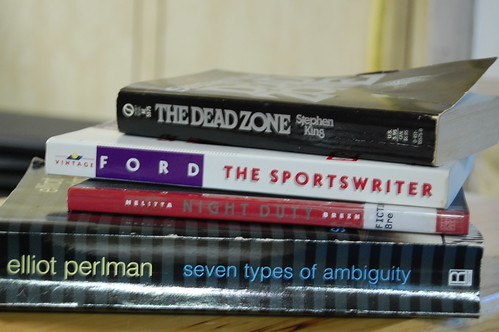 Case in point: Stephen King is a master of showing. In The Dead Zone he doesn't tell us that Greg Stillson is an evil man, he shows us by having him sell cheap, overpriced Bibles to rural residents which fall apart days after the purchase, and most of all, by kicking a farm dog to death for no reason other than it annoyed him. He doesn't come right out and say this man is evil, he shows us.
It is easy for the reader to draw the right conclusion from the scene he presents. So whenever you have a choice, try to present the scene to the reader and not tell him what conclusions to draw from it. Let your words paint the picture and create the sensations of being there.
The Sportswriter – Richard Ford (1986)
This book makes you feel like you have sat down with an interesting person who is telling you his life story. This is an engaging first-person point of view, which suggests several of the conflicts to come within the story; giving up a literary career to be a sportswriter, unresolved grief from the death of the child, and possibly conflict with an ex-wife. There is no dialogue per se yet, but the description and the telling of the tale urges me to read on. On to the next round.
Seven Types of Ambiguity – Elliot Perlman (2003)
I like the concept described on the back cover the book. It is divided into seven sections with each having a completely different narrator, which changes the point of view dramatically. The book is covered with rave reviews on the back cover, front cover and inside pages. I also like the first person narrator voice for the first five pages because it is so conversational. The thing I like about this section is that the narrator describes the character, Simon, by how the narrator thinks he is seen by Simon. It's still unclear to me whether the narrator is male or female. I am very intrigued by this unusual point of view and the lyrical description of these characters. The seven section structure, mentioned on the back cover, also intrigues me. This one goes to the next round.
The Dead Zone – Stephen King (1980)
This book spawned a movie and a successful USA series starring Michael Anthony Hall, so what else does it need? It is amazing that I haven't read this book yet since it features some of my favorite subjects, Armageddon, predicting the future, and impossible choices. The other thing that makes this great is within the first five pages Stephen King shows that he's a master of showing not telling. He doesn't specifically tell us what Johnny's cryptic warning means when he awakens from the bump on the head which gave him predictive powers. He shows us. He doesn't tell us that Greg Stillson is an evil man, he shows us, and in such an intriguing way that compels you to keep reading. This one goes the next round.
Night Duty – Melitta Breznik (1999)
There are a couple things right off the bat that I do not like about this book. The first of which is the lack of any dialogue. Flipping through the first 20 or 25 pages of the book, I do not see any dialogue whatsoever, and long, dense paragraphs of text. The first pages provide detail for an autopsy and has a somewhat artificial beginning with "the story begins a long time before my birth, in the German city during the war…”
I don't like pages of long description with no hook, no apparent character or conflict. This one never had a chance. It is eliminated.
Books Eliminated So Far (and available if you want them):
Case in point: Stephen King is a master of showing. In The Dead Zone he doesn't tell us that Greg Stillson is an evil man, he shows us by having him sell cheap, overpriced Bibles to rural residents which fall apart days after the purchase, and most of all, by kicking a farm dog to death for no reason other than it annoyed him. He doesn't come right out and say this man is evil, he shows us.It is easy for the reader to draw the right conclusion from the scene he presents. So whenever you have a choice, try to present the scene to the reader and not tell him what conclusions to draw from it. Let your words paint the picture and create the sensations of being there.
The Sportswriter – Richard Ford (1986)
This book makes you feel like you have sat down with an interesting person who is telling you his life story. This is an engaging first-person point of view, which suggests several of the conflicts to come within the story; giving up a literary career to be a sportswriter, unresolved grief from the death of the child, and possibly conflict with an ex-wife. There is no dialogue per se yet, but the description and the telling of the tale urges me to read on. On to the next round.
Seven Types of Ambiguity – Elliot Perlman (2003)
I like the concept described on the back cover the book. It is divided into seven sections with each having a completely different narrator, which changes the point of view dramatically. The book is covered with rave reviews on the back cover, front cover and inside pages. I also like the first person narrator voice for the first five pages because it is so conversational. The thing I like about this section is that the narrator describes the character, Simon, by how the narrator thinks he is seen by Simon. It's still unclear to me whether the narrator is male or female. I am very intrigued by this unusual point of view and the lyrical description of these characters. The seven section structure, mentioned on the back cover, also intrigues me. This one goes to the next round.
The Dead Zone – Stephen King (1980)
This book spawned a movie and a successful USA series starring Michael Anthony Hall, so what else does it need? It is amazing that I haven't read this book yet since it features some of my favorite subjects, Armageddon, predicting the future, and impossible choices. The other thing that makes this great is within the first five pages Stephen King shows that he's a master of showing not telling. He doesn't specifically tell us what Johnny's cryptic warning means when he awakens from the bump on the head which gave him predictive powers. He shows us. He doesn't tell us that Greg Stillson is an evil man, he shows us, and in such an intriguing way that compels you to keep reading. This one goes the next round.
Night Duty – Melitta Breznik (1999)
There are a couple things right off the bat that I do not like about this book. The first of which is the lack of any dialogue. Flipping through the first 20 or 25 pages of the book, I do not see any dialogue whatsoever, and long, dense paragraphs of text. The first pages provide detail for an autopsy and has a somewhat artificial beginning with "the story begins a long time before my birth, in the German city during the war…”
I don't like pages of long description with no hook, no apparent character or conflict. This one never had a chance. It is eliminated.
Books Eliminated So Far (and available if you want them):
- 21 – Jeremy Iversen (2005)
- Farm Fatale – Wendy Holden (2001)
- Freezing -- Penelope Evans (1997)
- Stronghold: Dragonstar Book 1 – Melanie Rawn (1990)
- Man of the House – Stephen McCauley (1996)
- Strawberry Tattoo -- Lauren Henderson (1999)
- Lying Awake -- Mark Salzman (2000)
- The Feast of Love -- Charles Baxter (2000)
- Love Invents Us -- Amy Bloom (1997)
- Night Duty – Melitta Breznik (1999)
- Lord of Chaos (Wheel of Time Book 6) – Robert Jordan (1995)
- Crown of Swords (Wheel of Time Book 7) – Robert Jordan (1997)
Friday, September 02, 2011
Letter to Your 16 Year-Old Self
This sounds like an interesting book and an interesting writing exercise. Dear Me: A Letter to My Sixteen-Year-Old Self, edited by Joseph Galliano (Atria, $20, on-sale Oct. 25) with J.K. Rowling writing the forward to it.
I always have remembered my teenaged years as mostly miserable. A feeling of straining to reach for grown-up responsibilities combined with fear of them while mourning for a childhood that was too quickly eroding away.
Having reconnected with many of the kids I grew up with on Facebook, I now realize that these feelings were pretty universal, even for those who I saw as “having it all together,” with normal families, great academic performance, with hot girlfriends and boyfriends and respect as athletes.
I fit into none of these groups and hung out with friends who played Dungeons & Dragons, watched sci-fi TV, explored the forests in our neighborhoods, read comic books and listened to pop and classic rock music and endlessly discussed and argued about the nuances of them all.
At 16, I felt at my core that I was hopelessly geeky and stupid. I was embarrassed that I was a terrible driver who took over 18 months to get my license when most boys tested and received it on their 16th birthdays.
I liked a lot of girls and even dated a few, but didn’t really know how to talk to them. I was so afraid of saying something stupid or revealing the true geek I was, that conversations with them often contained long, awkward silences. Academically, I struggled mightily at math and science while in English, which I considered by best subject, I was convinced that being placed in the Advanced Placement program was a mistake.
I would have loved to play football or baseball, as a passionate fan of these games, but I was awkward and uncoordinated with no natural ability, and as I discovered as an adult, very poor depth perception that made it almost impossible to judge the speed and distance of an approaching fastball, or where I had to stand to catch a punt. I grew quickly and was skinny despite all of my efforts to bulk up by drinking milkshakes packed with raw eggs and eating tremendous amounts of food at every meal. Occasionally, I worked out with the encouragement of my friends, even though I was mortified by how weak I was and extremely self-conscious of it. I hated it, so it never lasted.
I knew so little about the world and was afraid of so much of it. I felt like the world had a giant blueprint of how you were supposed to act and what you were supposed to know that everyone else had been given, but I somehow I missed that day at school and fell left behind. Above all I just wanted people to like me, and was mystified when a few people did not.
I think the teenage years, which are worshiped in our culture as being wonderful and carefree, are a mass of hard choices, unfair rules, and unwritten codes. It is a world where adults are skeptical of, or actively dislike you. It is a confusing time where we are introduced to sex, drugs, death, violence and alcohol. Even if you weren’t involved with any of these, you are exposed to it. And all the while you are completely unprepared to deal with it, and the knowledge that our parents weren’t perfect or had all of the answers we needed (or didn't want to hear us ask the questions if they did). For most of us, these were some of the worst years of our lives, filled with regret and bad decisions.
There are lots of things I’d like to go back and tell my 16 year-old self, but I think I can boil it all down to this:
What would you tell your 16 year-old self?
I always have remembered my teenaged years as mostly miserable. A feeling of straining to reach for grown-up responsibilities combined with fear of them while mourning for a childhood that was too quickly eroding away.
 |
| Courtesy of Arty Smokes via Flickr |
I fit into none of these groups and hung out with friends who played Dungeons & Dragons, watched sci-fi TV, explored the forests in our neighborhoods, read comic books and listened to pop and classic rock music and endlessly discussed and argued about the nuances of them all.
At 16, I felt at my core that I was hopelessly geeky and stupid. I was embarrassed that I was a terrible driver who took over 18 months to get my license when most boys tested and received it on their 16th birthdays.
I liked a lot of girls and even dated a few, but didn’t really know how to talk to them. I was so afraid of saying something stupid or revealing the true geek I was, that conversations with them often contained long, awkward silences. Academically, I struggled mightily at math and science while in English, which I considered by best subject, I was convinced that being placed in the Advanced Placement program was a mistake.
I would have loved to play football or baseball, as a passionate fan of these games, but I was awkward and uncoordinated with no natural ability, and as I discovered as an adult, very poor depth perception that made it almost impossible to judge the speed and distance of an approaching fastball, or where I had to stand to catch a punt. I grew quickly and was skinny despite all of my efforts to bulk up by drinking milkshakes packed with raw eggs and eating tremendous amounts of food at every meal. Occasionally, I worked out with the encouragement of my friends, even though I was mortified by how weak I was and extremely self-conscious of it. I hated it, so it never lasted.
I knew so little about the world and was afraid of so much of it. I felt like the world had a giant blueprint of how you were supposed to act and what you were supposed to know that everyone else had been given, but I somehow I missed that day at school and fell left behind. Above all I just wanted people to like me, and was mystified when a few people did not.
I think the teenage years, which are worshiped in our culture as being wonderful and carefree, are a mass of hard choices, unfair rules, and unwritten codes. It is a world where adults are skeptical of, or actively dislike you. It is a confusing time where we are introduced to sex, drugs, death, violence and alcohol. Even if you weren’t involved with any of these, you are exposed to it. And all the while you are completely unprepared to deal with it, and the knowledge that our parents weren’t perfect or had all of the answers we needed (or didn't want to hear us ask the questions if they did). For most of us, these were some of the worst years of our lives, filled with regret and bad decisions.
There are lots of things I’d like to go back and tell my 16 year-old self, but I think I can boil it all down to this:
“Relax and don’t be so hard on yourself. You don’t have to be perfect all of the time. It doesn't matter what other people think of you, just what you believe in your heart. Don't let anyone make you feel stupid, ugly or unloved. You are a great person with a great future ahead of you. Believe it and hold on just a little longer.”
What would you tell your 16 year-old self?
Monday, August 29, 2011
5 Things I Learned About Writing by Building a Tree House
Although the tree house is not completely finished, it is nearly complete, and I learned a few things while completely out of my element during the last phases of construction.
1. You don’t have to have a precise plan.
When you start a project, you don’t need an exact plan, as long as you have a rough idea of what you think the final product should look like at the end.
Our tree house plan was sketched out on 2 pieces of graph paper on the first morning of construction and provided all of the necessary info to complete the project.
If you are stuck on a writing project: Get a sheet of paper, even a plain piece of paper, and set a timer for 15 minutes and write down everything you can think of about the project. Feel free to MindMap the idea, cut and paste words and pictures from other sources, ask questions, etc. Add more pages if necessary. Use this as the basis of your project.
2. You don’t have to take on a big project alone.
It is always good to have a crew to help you out. Whether it is writing buddy that you can bounce ideas off of, a group of reliable peers to critique your writing, or a good editor to help perfect your prose toward the end of the project, you don’t have to bear the entire burden of the project alone. So hook up with a group of writers either locally or online, but preferably nearby so you can get some needed social time with other word lovers.
3. The right tools make all of the difference in the world.
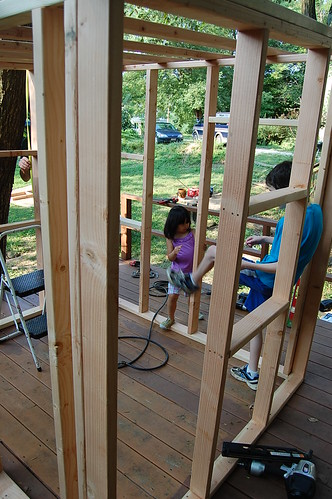
Even when writing it is important to know what tools you need and how to use them properly. Word choice, grammar, and when you must follow and break the rules are critical to getting a project done.
Knowing how to use the thesaurus, your word processor, research tools and methods, and grammar resources are almost as important as the writing process itself. So invest in the best tools your money can buy and learn how to use them.
4. You can get a lot done in a hurry if you have a goal.
Two days from wobbly deck to framed, walled and roofed tree house. They were 8 to 9 hour days, but consistent effort got us there. If you find a gap of time, whether it is 15 minutes, a couple of hours, or a couple of days, focus all of your effort on getting as much as you can done in that amount of time.
Working fast can give you the push and momentum to keep going, even when you hit a difficult spot.
5. Seek advice from experts.
My Dad is a mechanical genius. He can fix, build, renovate or refurbish anything. He taught people how to run and repair heavy equipment (cranes, bulldozers, graders, etc.) for over 30 years. He dug a pond in our backyard, built a barn, deck, and transformed a cinder block basement into a family room and bedroom. He has built gazebos and go carts, clocks, cedar chests and entertainment centers. There is nothing he cannot do with his hands.
Unfortunately, his genius apparently has skipped a generation. I am barely qualified to shop for myself at Home Depot. Any project I take on takes forever to finish, with many trips back and forth to the hardware store, with a lot of trial and error in between, to get a job done.
It is OK to seek the counsel of those who are more knowledgeable and experienced than you.
It often saves a lot of time and wasted effort. Most people are flattered and pleased when you come to them seeking advice and generous with their expertise. So seek out mentors and experts to help you along in your journey. People often forget that writing is, at heart, a collaborative art, where one writer’s work often builds upon or borrows from many other writers.
My Dad gave up two entire days to help me make a dream for my kids come true. I don’t think that they believed that I’d ever get the tree house done, and without his help it probably never would have happened. I can never thank him enough for this gift. Thank you Dad!
1. You don’t have to have a precise plan.
When you start a project, you don’t need an exact plan, as long as you have a rough idea of what you think the final product should look like at the end.
Our tree house plan was sketched out on 2 pieces of graph paper on the first morning of construction and provided all of the necessary info to complete the project.
If you are stuck on a writing project: Get a sheet of paper, even a plain piece of paper, and set a timer for 15 minutes and write down everything you can think of about the project. Feel free to MindMap the idea, cut and paste words and pictures from other sources, ask questions, etc. Add more pages if necessary. Use this as the basis of your project.
2. You don’t have to take on a big project alone.
 |
| My cre |
3. The right tools make all of the difference in the world.
Even when writing it is important to know what tools you need and how to use them properly. Word choice, grammar, and when you must follow and break the rules are critical to getting a project done.
Knowing how to use the thesaurus, your word processor, research tools and methods, and grammar resources are almost as important as the writing process itself. So invest in the best tools your money can buy and learn how to use them.
4. You can get a lot done in a hurry if you have a goal.
Two days from wobbly deck to framed, walled and roofed tree house. They were 8 to 9 hour days, but consistent effort got us there. If you find a gap of time, whether it is 15 minutes, a couple of hours, or a couple of days, focus all of your effort on getting as much as you can done in that amount of time.
Working fast can give you the push and momentum to keep going, even when you hit a difficult spot.
5. Seek advice from experts.
My Dad is a mechanical genius. He can fix, build, renovate or refurbish anything. He taught people how to run and repair heavy equipment (cranes, bulldozers, graders, etc.) for over 30 years. He dug a pond in our backyard, built a barn, deck, and transformed a cinder block basement into a family room and bedroom. He has built gazebos and go carts, clocks, cedar chests and entertainment centers. There is nothing he cannot do with his hands.
Unfortunately, his genius apparently has skipped a generation. I am barely qualified to shop for myself at Home Depot. Any project I take on takes forever to finish, with many trips back and forth to the hardware store, with a lot of trial and error in between, to get a job done.
 |
| Picture of a man not qualified to shop for himself at Home Depot |
It often saves a lot of time and wasted effort. Most people are flattered and pleased when you come to them seeking advice and generous with their expertise. So seek out mentors and experts to help you along in your journey. People often forget that writing is, at heart, a collaborative art, where one writer’s work often builds upon or borrows from many other writers.
My Dad gave up two entire days to help me make a dream for my kids come true. I don’t think that they believed that I’d ever get the tree house done, and without his help it probably never would have happened. I can never thank him enough for this gift. Thank you Dad!
Friday, August 26, 2011
Weekly Word Count – August 15th through August 21st 2011
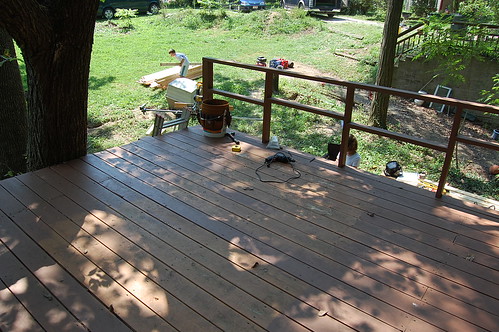
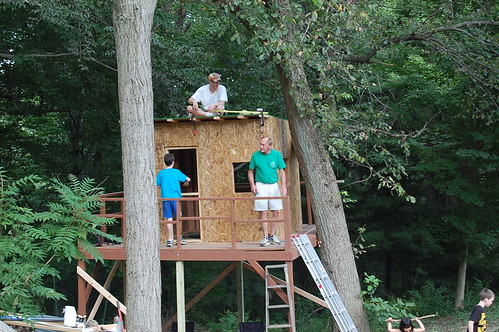
Actually, I didn’t build it, I just helped. My Dad visited for a couple of days and created a plan out of my vague idea of what I wanted for the kids. The first thing we had to do was “fix-up” phase one of the plan, which was the deck that took me all of last summer to build. A pretty good effort according to my Dad, who is a certified expert in such things, except for the fact that it needed to be reinforced in order to make it safer. Then once he figured out all of the angles for the construction so it would have a sloped roof, we constructed the frame of the house.
So day one of the process consisted of, looking at the deck, figuring out how large the tree house was going to be (5’ by 7’), what design we wanted (doors, windows, type of roof) and then creating a shopping list.
Then it was off to Menard's where we purchased 40 2x4x8’s, 10 sheets of plywood, one roll of roofing material, 3 additional 4x4x8’s to reinforce the deck, some aluminum screen, door hinges and hardware and we were ready to roll. By noon we had everything that we needed and began construction.
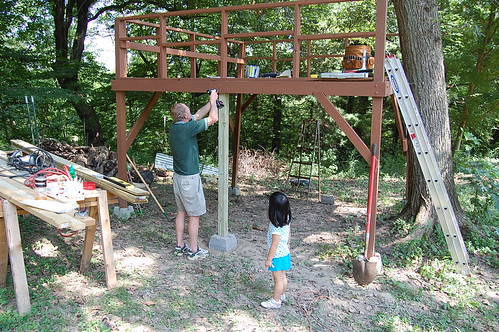 As Dad and I reinforced the deck, the boys unloaded the lumber out of the van. One the deck was properly reinforced, we began cutting and constructing the sides of the house on the ground. It is amazing how easy a construction project can be when you have the right tools. With my dad’s saw and nail gun, the sides were assembled and good to go by 7pm on the first day.
 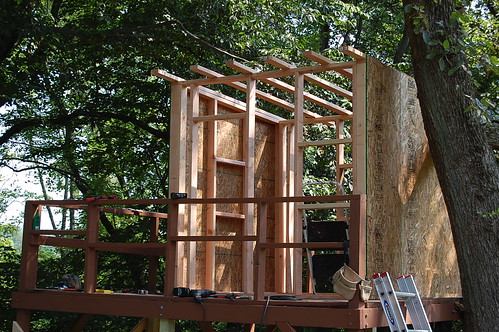 On Day 2, we lifted the walls up onto the deck, clamped them together, nailed them in place and then began cutting the plywood sides for the house. While this was going on, I laid the roof beams in place and settled the plywood for the roof in place. This was completed by lunchtime.
After a quick lunch of Nick’s Pizza and sweet corn from Neely’s farm I worked on nailing the plywood for the room in place while Dad and Ben marked and cut out the door for the house. Once I had the first part of the roof in place, I was “trapped” on the roof while screwing the entire roof down tight from on top. While Dad and Leah cut out the windows for the house, I nailed the rolled roofing into place on the roof. A very hot job.
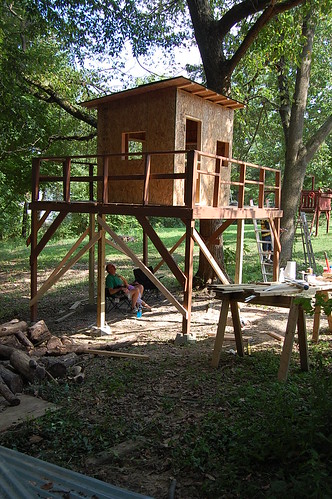 And by 5pm, all that is left to do is painting and putting the screens for the door and windows in place. I am amazed what a difference that 2 days can make.
In addition almost another day was sucked up by taking Addie to Cincinnati for an appointment with a specialist at Cincinnati Children’s Hospital. Figure in the 2 hour drive each way, the 2 hours for the appointment itself, and then (of course) lunch at a Chinese restaurant afterwards and the day is pretty much shot.
What does this have to do with the Weekly Word Count? Not a lot, other than giving me a tale to tell to pad the word count at the end of the week with some nifty pictures to boot, and a couple of lessons about the project that can be translated over from the construction realm to writing. Word Count for the Week: 1,789.
I’m not going to bother breaking it down for you… Next week will be better I promise. Next Week: Lessons I Learned About Writing from Building a Tree House!
Wednesday, August 24, 2011
Reading Elimination Tournament – Round 1: Set the Right Pace
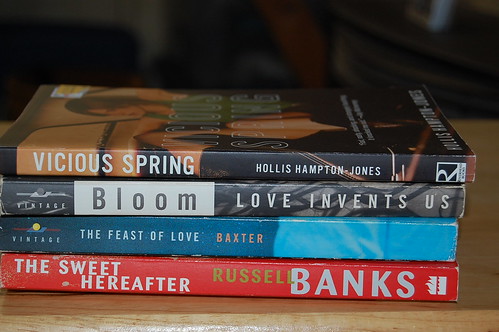 Pacing is a challenge for any modern day fiction writer. It seems like our literature now reflects our frenetic-paced lives. The story has to burst from the gate and leap into a story immediately, while not confusing the reader with too little information or boring the reader with too much. Pacing is a difficult balance to maintain throughout an entire story, but in the first five pages it is like walking on a high wire without a net or a clown to break your fall. You need to engage the reader and hook him/her into the story with a bit of mystery, but not too much mystery or you lose the reader’s attention.
Which of your favorite stories or novels have fantastic beginnings? Who are the authors that are the masters of stringing the reader along keeping them up way too late reading? Post them in the comments below.
Vicious Spring – Hollis Hampton Jones (2003)
First of all there is a great cover quote from Jay McInerney: “Fast, nasty, shocking and strangely touching. It knocked me out.” This coming from author of the granddaddy of all party books: Bright Lights, Big City. The back cover and the first five pages reveal a narrator who does drugs because she's bored, has a boyfriend in his 30’s who works at a strip club, and she becomes a lap dancer. The first five pages include drugs, suggestions of sex, senseless vandalism and the fire alarm sprinklers going off inside school. It has interesting narrative voice and an intriguing first-person point of view that I want to read more about. On to the next round.
Love Invents Us – Amy Bloom (1997)
The back cover promises realistic characters and interesting situations. The first part of the book is about Elizabeth, an elementary school-aged girl who is modeling first with store owner. She, as the narrator, does not seem to be bothered by this action, although it feels a little creepy. He doesn't seem to molest her in any way, but you wonder what may happen later. Elizabeth seems to be starving for attention and love. The narrative voice is not that interesting in the beginning, and even though I want to see where the story might go, I’m afraid it will be somewhere very sad and ugly. I'm not sure that I’m up for this type of tale right now. This one is eliminated.
The Feast of Love – Charles Baxter (2000)
This one is weird because the narrator’s name is Charles Baxter which happens to be the name of the author. This one has a very slow start, talking about optical floaters that look like cogs in the machine in about of insomnia. This book is a National Book Award finalist, so I suppose I should give it more time, but there are a lot of books in this tournament and if I am honest with myself, the book doesn’t engage me enough to compel me to keep reading, so I am eliminating this one.
The Sweet Hereafter – Russell Banks (1991)
This book has many favorable blurbs, and of course, was an award-winning movie, which I haven't seen. Russell Banks has a very good reputation and the back cover copy promises a morality play that addresses one of life's most agonizing questions: When the worst thing happens, who could you blame? The first five pages are told from the point of view of what I think is a bus driver, who has hit something. This has happened in the past, and suggests, or at least makes me think, that a child was hit. This novel seems to start off a little slow, but I think I want some more time to read this to see if it can recover from the slow start by reading an additional 20 pages or so. But again, there are many tough choices ahead of me to cut this list down to 32, so I'll list this as a maybe for now.
Books Eliminated So Far (and available if you want them):
- 21 – Jeremy Iversen (2005)
- Farm Fatale – Wendy Holden (2001)
- Freezing -- Penelope Evans (1997)
- Stronghold: Dragonstar Book 1 – Melanie Rawn (1990)
- Man of the House – Stephen McCauley (1996)
- Strawberry Tattoo -- Lauren Henderson (1999)
- Lying Awake -- Mark Salzman (2000)
- The Feast of Love -- Charles Baxter (2000)
- Love Invents Us -- Amy Bloom (1997)
- Lord of Chaos (Wheel of Time Book 6) – Robert Jordan (1995)
- Crown of Swords (Wheel of Time Book 7) – Robert Jordan (1997)
Monday, August 22, 2011
Weekly Word Count –August 8th through August 14th 2011
**NOTE: Sorry for the delay on last week's Weekly Word Count. I had it written, just forgot to post it (along with several other blog posts last week) so today you are getting 2 for 1!**
Week 2 of being free from my day job has been a bit of a transition. A simple post on Facebook asking for freelance assignments generated a lot of help from my friends, acquaintances and former students. They forwarded job postings, leads on good companies to consider, and even a couple of possible future assignments. All this being said, I am disappointed with my output again last week: a mere 2,754 words.
My best day was Friday with 1,579 words, 1,205 of which were a white paper draft for a client. I wrote no new content for the blogs last week, only tweaked a couple of articles that were already waiting to be posted. Another 329 words were devoted to my “business plan” which is more of an all-encompassing task list of the things I need to do to make this writing biz happen. This is good for helping me think on paper about all of the things that need to be done and roughly in what order. The rest of the words were strictly job search related. In other words, very little creative output at all. The days sort of blended together with my mood swerving from cool confidence to stomach sinking panic. Depending on the day and the content of my email inbox.
I realized that I still have a lot of things to do. I needed to gather writing samples from all of my recent writing projects for an online portfolio, which has become a bit of a problem since some of my writing samples were still on 3.5” diskettes, and none of the three old computers I had with floppy drives were functioning. Enter eBay and $12.99 for a new USB floppy drive delivered on Monday, and I was sifting through a massive data jungle filled with my obsessive need to back up everything repeatedly, but never seeming to overwrite older files. I’ve now located a couple of dozen files which might serve as possible writing samples. I’m trying to gather a variety of different documents to show off the scope of my writing talent.
I also needed to install WordPress onto my primary website which was challenging to sift through all of the data transfer and behind the scenes set up with the web hosting service, but it is done, Now all I have to do is configure and launch it when I’m ready. Which will hopefully be next week.
Then over the weekend I forced myself to get out of my office and head down to the local coffee shop for our monthly writers group meeting and spent the rest of the weekend with family… So two of my (traditionally) most productive days were completely empty of words which also dragged the count down.
I don’t know what this really says about me or my situation other than reinforcing that there is NEVER a perfect time to write. Even if you have a lot of time, life tends to find ways to seep into it and leach a little of it away.
This week is a new week and there is a lot planned for it, so I’m definitely going to need to manage it well and get stuff done whenever I can.
Week 2 of being free from my day job has been a bit of a transition. A simple post on Facebook asking for freelance assignments generated a lot of help from my friends, acquaintances and former students. They forwarded job postings, leads on good companies to consider, and even a couple of possible future assignments. All this being said, I am disappointed with my output again last week: a mere 2,754 words.
My best day was Friday with 1,579 words, 1,205 of which were a white paper draft for a client. I wrote no new content for the blogs last week, only tweaked a couple of articles that were already waiting to be posted. Another 329 words were devoted to my “business plan” which is more of an all-encompassing task list of the things I need to do to make this writing biz happen. This is good for helping me think on paper about all of the things that need to be done and roughly in what order. The rest of the words were strictly job search related. In other words, very little creative output at all. The days sort of blended together with my mood swerving from cool confidence to stomach sinking panic. Depending on the day and the content of my email inbox.
I realized that I still have a lot of things to do. I needed to gather writing samples from all of my recent writing projects for an online portfolio, which has become a bit of a problem since some of my writing samples were still on 3.5” diskettes, and none of the three old computers I had with floppy drives were functioning. Enter eBay and $12.99 for a new USB floppy drive delivered on Monday, and I was sifting through a massive data jungle filled with my obsessive need to back up everything repeatedly, but never seeming to overwrite older files. I’ve now located a couple of dozen files which might serve as possible writing samples. I’m trying to gather a variety of different documents to show off the scope of my writing talent.
I also needed to install WordPress onto my primary website which was challenging to sift through all of the data transfer and behind the scenes set up with the web hosting service, but it is done, Now all I have to do is configure and launch it when I’m ready. Which will hopefully be next week.
Then over the weekend I forced myself to get out of my office and head down to the local coffee shop for our monthly writers group meeting and spent the rest of the weekend with family… So two of my (traditionally) most productive days were completely empty of words which also dragged the count down.
I don’t know what this really says about me or my situation other than reinforcing that there is NEVER a perfect time to write. Even if you have a lot of time, life tends to find ways to seep into it and leach a little of it away.
This week is a new week and there is a lot planned for it, so I’m definitely going to need to manage it well and get stuff done whenever I can.
Tuesday, August 09, 2011
Reading Elimination Tournament – Boldly Go Where You Have Never Gone Before
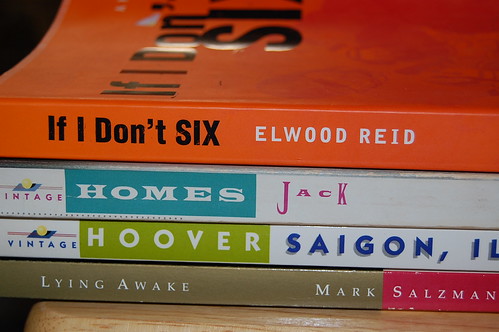
A good writer can immerse you in a world that you have no knowledge of and make you believe in it. Every detail. Every aspect of it. In this edition’s Reading Elimination Tournament entries, all four authors do this: Elwood Reid, takes us into the realm of Big-Ten college football as an elite athlete. Mark Saltzman takes us into a Carmelite monastery outside of Los Angeles to see life through the eyes of a nun. Paul Hoover travels through time back to the late 1960’s to experience home life through the point of view of a conscientious objector in small town Illinois. Finally, A.M Homes (a woman, for those of you who are not familiar with her) leaps into the body of a nervous, insecure teenage boy about to experience drastic changes in his life.
 As a reader, the writer has to make me trust that you know what you are talking about. You have to set up scenes with specific details, riveting dialog, and engaging events that the average reader can relate to and believe possible. And the writer has to make it interesting, or at least interesting enough to keep the reader turning pages.
The first five pages should establish what the world of the book is about. Where are we? When are we? Who are we? What are we going to learn about this subject that we may or may not know about? If we know about it, is it true? If we don’t know about it, is it interesting? What are the rules of this world? Are there conflicts already brewing? The first five pages are critical for setting the expectations for the reader.
If I Don't Six – Elwood Reid (1998)
This story feels like a realistic tale about an interesting situation; the life of the elite collegiate athlete. The protagonist is a jock, one who is self-aware enough to reveal interesting insights which go beyond the surface. It grabs my attention and holds it. The protagonist is also from Cleveland, so Ohio plays a prominent role within the story, and is another reason the story interests me. The author manages to define other characters through vivid actions and insights revealed with the dialogue. This is very well done and goes on to the next round.
Saigon, Illinois – Paul Hoover (1988)
This book is set in the late 1960s it starts off with the main character Holder, setting up his appeal as a conscientious objector to avoid the draft for the Vietnam War. You can tell from the interactions between the draft board and Holder that he is a one of those clever and somewhat funny characters that you would like to learn more about. He seems to be in the midst of much of the conflict that occurs during that era. I like the character enough that I might want to move this on to the next round, but it is on the borderline. So it’s going into the maybe pile for now, but I’m leaning toward passing it to the next round.
Jack – A. M. Homes (1989)
This book starts in the middle of a driving lesson with a nervous teenage narrator in the driver’s seat. I like the observations of the narrator when dad takes over behind the wheel. Jack’s description comparing how his dad does the things that an experienced driver does without thinking, and the labor-intensive thought process of a beginning driver is great and true-to-life is brilliant. The character is likable and his observations interesting. Homes does a good job of presenting the teenage mind. I'm going to put this one on the maybe pile, but I'm leaning toward sending it to the next round.
Lying Awake – Mark Salzman (2000)
This one has an interesting premise; a nun has spiritual enlightenment, but also dangerous headaches which may require medical intervention. Are the two related? This is another book that starts out slow, describing the details of life in a convent. The structure is interesting, short paragraphs broken up with lines of prayer in between. The problem is that little is revealed about the character, we don’t even know her name yet, just the details of daily life of a Carmelite nun. There is not a hint of conflict within these pages either. The back cover promises that it is coming, but I don’t think that interesting description is enough to overcome the lack of character definition or conflict. I’m eliminating this one.
Books Eliminated So Far (and available if you want them):
As a reader, the writer has to make me trust that you know what you are talking about. You have to set up scenes with specific details, riveting dialog, and engaging events that the average reader can relate to and believe possible. And the writer has to make it interesting, or at least interesting enough to keep the reader turning pages.The first five pages should establish what the world of the book is about. Where are we? When are we? Who are we? What are we going to learn about this subject that we may or may not know about? If we know about it, is it true? If we don’t know about it, is it interesting? What are the rules of this world? Are there conflicts already brewing? The first five pages are critical for setting the expectations for the reader.
If I Don't Six – Elwood Reid (1998)
This story feels like a realistic tale about an interesting situation; the life of the elite collegiate athlete. The protagonist is a jock, one who is self-aware enough to reveal interesting insights which go beyond the surface. It grabs my attention and holds it. The protagonist is also from Cleveland, so Ohio plays a prominent role within the story, and is another reason the story interests me. The author manages to define other characters through vivid actions and insights revealed with the dialogue. This is very well done and goes on to the next round.
Saigon, Illinois – Paul Hoover (1988)
This book is set in the late 1960s it starts off with the main character Holder, setting up his appeal as a conscientious objector to avoid the draft for the Vietnam War. You can tell from the interactions between the draft board and Holder that he is a one of those clever and somewhat funny characters that you would like to learn more about. He seems to be in the midst of much of the conflict that occurs during that era. I like the character enough that I might want to move this on to the next round, but it is on the borderline. So it’s going into the maybe pile for now, but I’m leaning toward passing it to the next round.
Jack – A. M. Homes (1989)
This book starts in the middle of a driving lesson with a nervous teenage narrator in the driver’s seat. I like the observations of the narrator when dad takes over behind the wheel. Jack’s description comparing how his dad does the things that an experienced driver does without thinking, and the labor-intensive thought process of a beginning driver is great and true-to-life is brilliant. The character is likable and his observations interesting. Homes does a good job of presenting the teenage mind. I'm going to put this one on the maybe pile, but I'm leaning toward sending it to the next round.
Lying Awake – Mark Salzman (2000)
This one has an interesting premise; a nun has spiritual enlightenment, but also dangerous headaches which may require medical intervention. Are the two related? This is another book that starts out slow, describing the details of life in a convent. The structure is interesting, short paragraphs broken up with lines of prayer in between. The problem is that little is revealed about the character, we don’t even know her name yet, just the details of daily life of a Carmelite nun. There is not a hint of conflict within these pages either. The back cover promises that it is coming, but I don’t think that interesting description is enough to overcome the lack of character definition or conflict. I’m eliminating this one.
Books Eliminated So Far (and available if you want them):
- 21 – Jeremy Iversen (2005)
- Farm Fatale – Wendy Holden (2001)
- Freezing -- Penelope Evans (1997)
- Stronghold: Dragonstar Book 1 – Melanie Rawn (1990)
- Man of the House – Stephen McCauley (1996)
- Strawberry Tattoo -- Lauren Henderson (1999)
- Lying Awake -- Mark Salzman (2000)
- Lord of Chaos (Wheel of Time Book 6) – Robert Jordan (1995)
- Crown of Swords (Wheel of Time Book 7) – Robert Jordan (1997)
Monday, August 08, 2011
Weekly Word Count – August 1st through 7th, 2011
Okay this week's total 4264 words. Probably not as high as I would've liked, but okay considering the circumstances. The first thing to understand is that I lost my job on Monday so I was a bit busy wrapping up my work life at the company I’ve worked at for the last 10 years: Packing up my desk, turning in my laptop, processing paperwork, and saying goodbye to friends and co-workers who have been such a big part of my life for so long. It is hard to process when it happens to you, even if in your heart you believe that this is a good thing.
Luckily, I have some freelance work lined up and about half of those words written this week were devoted to working on a client project. The rest of the words were for the blogs and a little on updating my LinkedIn profile.
Losing your job is never a good thing but it does force you to make changes, and to be honest I was unhappy there for a very long time. I've always had this dream in the back of my head of making my own living as a freelance writer, and maybe this is the opportunity to do just that. I've been slowly preparing for this day for some time, buying equipment, software, office supplies, and trying to line up clients for possible future business, but it is difficult to work on any freelance projects when you have a full-time job. I'm not sure what the future holds, but I'm optimistic this change will be for the better.
For anyone who has the dream of having enough time to write that novel, that book or that screenplay, I now have it and I plan on exploiting it to the fullest.
This afternoon I have been reorganizing my office and beginning to assemble the research material for my next book: Creative Thinking for Creative Writers. I plan on beginning a draft or an outline by the end of the week. I have to fight through the nervousness and the temptation to spend all my time looking for a new full-time position because I know that this is not what I want, but I need to be realistic, and make sure that secondary parachute is packed and ready to go just in case of emergency.
So if you know of anyone who needs a good freelance writer with lots of technical and business experience, please let me know and stay tuned for more details about the journey. Thank you.
 |
| Courtesy of Ian Aberle via Flickr |
Losing your job is never a good thing but it does force you to make changes, and to be honest I was unhappy there for a very long time. I've always had this dream in the back of my head of making my own living as a freelance writer, and maybe this is the opportunity to do just that. I've been slowly preparing for this day for some time, buying equipment, software, office supplies, and trying to line up clients for possible future business, but it is difficult to work on any freelance projects when you have a full-time job. I'm not sure what the future holds, but I'm optimistic this change will be for the better.
For anyone who has the dream of having enough time to write that novel, that book or that screenplay, I now have it and I plan on exploiting it to the fullest.
This afternoon I have been reorganizing my office and beginning to assemble the research material for my next book: Creative Thinking for Creative Writers. I plan on beginning a draft or an outline by the end of the week. I have to fight through the nervousness and the temptation to spend all my time looking for a new full-time position because I know that this is not what I want, but I need to be realistic, and make sure that secondary parachute is packed and ready to go just in case of emergency.
So if you know of anyone who needs a good freelance writer with lots of technical and business experience, please let me know and stay tuned for more details about the journey. Thank you.
Friday, August 05, 2011
Reading Elimination Tournament – The Power of the First Sentence
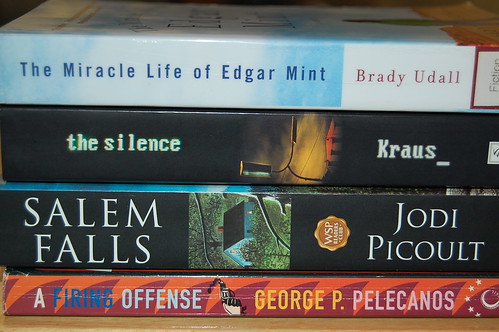 Never underestimate the power of the first sentence of a novel. That sentence sets the tone. That sentence is the first lure on your line to hook the reader. Just as the first five pages are critical, the first sentence is the most important words within those first five pages. For example, the first line from Salem Falls:
“Several miles into his journey, Jack St. Bride decided to give up his former life.”A character making a declaration, but characters making declarations always leads to conflict. Stating something shocking such as the first line from The Miracle Life of Edgar Mint:
“If I tell you only one thing about my life it would be this: when I was seven years-old the mailman ran over my head."This creates an image that is vivid and horrifying, but as the reader, you want to know what happened next. You NEED to know. So you keep on reading. That is the ideal first sentence.
A Firing Offense – George P. Pelecanos (1992)
This book establishes the setting on page 1 and the description is excellent. The narrator Nick Stephanos is an advertising director with an attitude who immediately gets into a conflict with his stuffed shirt boss. Good discussion and good dialogue in the first five pages carries this to the next round. Even though it is a mystery and we have yet to see any evidence of a crime, it doesn't matter. The strength of description and interesting narrator make this work and compels you to keep reading.
Salem Falls – Jodi Picoult (2001)
This book is by one of my current favorite authors, Jodi Picoult. The back cover copy promises conflict, and a modern-day witch-hunt for a stranger looking to bury his past, and the typical Jodi Picoult plot which dwells not in black and white but in shades of gray. The first five pages introduce Jack, who has just been released from prison. The other major character, Addie, is dealing with the arrest of her alcoholic father. Both are nice quick scenes, have good dialogue, and suggest the conflict to come. This one goes the next round.
The Silence – Jim Krause (2004)
The back cover promises a series of catastrophic natural events which throws the world into mass panic and a virtual silence. Communication systems and computer technologies are devastated. Law and order have all but vanished as domestic terrorism and vigilante justice battle to control the terrified population. The first five pages introduce three of the four major characters in the book and hints at the conflict about to ensue. It seems to be starting slow, but I will give it a benefit of the doubt. The writer might just need a little more time to develop his premise. I want to read more so this one moves on to the next round.
The Miracle Life of Edgar Mint – Brady Udall (2001)
As mentioned in the opening paragraph above, a good way to start a book is with a sentence that either shocks or provokes you to keep reading to find out more. This book paints an image of a highly dysfunctional family and yet has good description that helps you see the world where the protagonist lives. It has a first-person point of view and I want to know more about the character. I’m passing this one on to round two.
Tuesday, August 02, 2011
Weekly Word Count: Summary of July 2011
Does anyone else do this? Last month, I moved away from my model of tracking the amount of time I spent writing (in 15-minute increments of course) to tracking actual word count. I had the optimistic goal of writing 30,000 words (a little under 1000 words or 4 double-spaced typed pages a day). I considered these words to be “raw output” for blog entries, freelance work and my creative projects.
I thought, hmm 1000 words of raw output shouldn’t be hard at all. Using Dragon Naturally Speaking some of the time, I should be able to crank out that much and still have time for editing some of the raw words into content… Right? Wrong. Most days I generated between 300 and 500 words. July’s grand total: 13,026 words, for a daily average of about 434 words, or a little under half of my goal.
I found that I had hit good word count numbers during the early part of the month, getting more than 1300 words for several days. It really wasn’t that hard. The problem was that the rough output was not publishable, especially the words generated by using Dragon Naturally Speaking. The program worked well, but in the situations where it didn’t work, it created errors that would be embarrassing if it was sent out there. Dragon is working out to be a decent tool, but it does require careful editing, because it does manage to enter the wrong word occasionally and those wrong words are not going to be caught by the spell check.
Later in the month, a lot of rewriting of the raw output reduced the daily word count significantly. I also had some freelance work that didn’t help me boost the numbers since it required a lot of editing and several revisions.
This month I’m changing the approach a little and not only tracking the daily word count, but the number of words generated for each of my writing projects. I am planning to go well beyond last month’s 30,000 word goal (for reasons to be explained next week) and I’ll try to keep track of what I manage to achieve in 15 minute. I’ll post a summary every Monday so you can see my progress. So until next Monday… keep on writing!
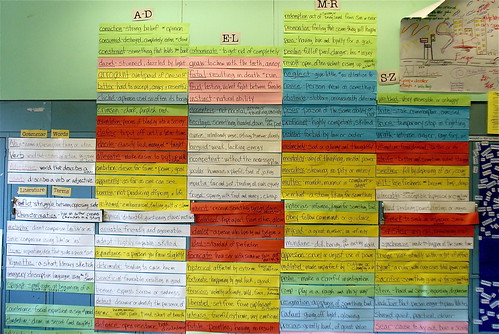 |
| Courtesy of cinderellasg via Flickr |
I thought, hmm 1000 words of raw output shouldn’t be hard at all. Using Dragon Naturally Speaking some of the time, I should be able to crank out that much and still have time for editing some of the raw words into content… Right? Wrong. Most days I generated between 300 and 500 words. July’s grand total: 13,026 words, for a daily average of about 434 words, or a little under half of my goal.
I found that I had hit good word count numbers during the early part of the month, getting more than 1300 words for several days. It really wasn’t that hard. The problem was that the rough output was not publishable, especially the words generated by using Dragon Naturally Speaking. The program worked well, but in the situations where it didn’t work, it created errors that would be embarrassing if it was sent out there. Dragon is working out to be a decent tool, but it does require careful editing, because it does manage to enter the wrong word occasionally and those wrong words are not going to be caught by the spell check.
Later in the month, a lot of rewriting of the raw output reduced the daily word count significantly. I also had some freelance work that didn’t help me boost the numbers since it required a lot of editing and several revisions.
This month I’m changing the approach a little and not only tracking the daily word count, but the number of words generated for each of my writing projects. I am planning to go well beyond last month’s 30,000 word goal (for reasons to be explained next week) and I’ll try to keep track of what I manage to achieve in 15 minute. I’ll post a summary every Monday so you can see my progress. So until next Monday… keep on writing!
Thursday, July 28, 2011
Reading Elimination Tournament - Round 1: Style Matters
These four books present distinct approaches to the first five pages. Each of them establishes a writing style which the reader can expect throughout the rest of the book. Style can establish a unique narrative voice; establish the rules within the world of the book or the pacing of the action within the book. Sometimes you don’t need a lot of conflict or action to hook the reader in… if you do it well.
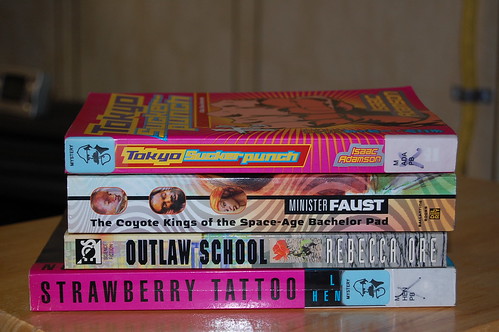 Strawberry Tattoo – Lauren Henderson (1999)
This one has an interesting cover, but the language and description on the first few pages seems forced and not very engaging. The first two pages are taken up with a dream sequence and nothing really seems to happen. No hint of conflict (other than vague assertions that the character did something “very bad” due to a alcohol/chemical induced blackout). This provides no real hint of who the narrator is or what she wants. It also claims to be a mystery on the inside cover flap. If it is, it starts way too slow for a mystery and there is no evidence of a crime at all within the first five pages. There is nothing here that makes me want to keep on reading. I'm eliminating this one.
Outlaw School – Rebecca Ore (2000)
On the first page of this book we encounter the protagonist, Jane’s, first memory; a memory of absolute terror. Through this scene you get an indication of how bad of a mother she has and one of the obstacles that Jane will have to overcome even before she faces the Orwellian society outside of her family. Jane possesses great intelligence, and this doesn't fit within the society of this book. The first five pages presents a world where people are tightly controlled by the class into which they are born in, not by intelligence or abilities. An interesting world sketched within the first five pages that I want to read more about. This one goes on to round two.
The Coyote Kings of the Space Age Bachelor Pad – Minister Faust (2004)
First of all, an intriguing title earns a +1 bonus. The character (narrator) is an honors English major (another +1 for an English major character… English majors always get a bad rap). An epilogue at the very beginning of the book? Unusual, but this supports the style established by the unique book title and cover design. The narrative voice is interesting and engaging (+1). Character information is presented in a role-playing game-like sheet (I love when authors find clever ways of presenting or introducing characters in such a way that does not seem forced +1). Pop culture references to Star Wars, Star Trek and comic books within the first five pages and on the back cover, not only helps establish the writing style, but all appeal to the geek in me (+3… one for each geek reference). With the arbitrary +7 score, this one’s a no brainer and going to the next round.
Tokyo Sucker Punch – Isaac Adamson (2000)
This book has a protagonist from Cleveland which is a big plus. (I’ll even give this an arbitrary +1 score for that.) Cleveland, like English majors, always gets a bad rap… I mean when was the last time you saw Cleveland mentioned in the national media without a joke attached to it? Having grown up in the Cleveland area (even though I don’t live there now) I still get offended by this… Anyway, I digress…
The back cover copy suggests an interesting combination part noir detective novel and part Chinese martial arts film. The first five pages have plenty of action, including the geisha in distress and a fight between the protagonist and Yakuza. It is sort of interesting, but not that engaging to me. I can't put my finger on what I don’t like about it. The author isn’t from the Cleveland area though so this might end up being a sly dig on Cleveland (the butt of the joke again), but the Adamson does not come across this way (yet) Maybe I need a few more pages to make a definitive decision, but there are many good books in this round and the arbitrary +1 score might not be enough to save it from elimination this round. It is a maybe for now, but definitely leaning heavily towards elimination.
Books Eliminated So Far (and available if you want them):
This one has an interesting cover, but the language and description on the first few pages seems forced and not very engaging. The first two pages are taken up with a dream sequence and nothing really seems to happen. No hint of conflict (other than vague assertions that the character did something “very bad” due to a alcohol/chemical induced blackout). This provides no real hint of who the narrator is or what she wants. It also claims to be a mystery on the inside cover flap. If it is, it starts way too slow for a mystery and there is no evidence of a crime at all within the first five pages. There is nothing here that makes me want to keep on reading. I'm eliminating this one.
Outlaw School – Rebecca Ore (2000)
On the first page of this book we encounter the protagonist, Jane’s, first memory; a memory of absolute terror. Through this scene you get an indication of how bad of a mother she has and one of the obstacles that Jane will have to overcome even before she faces the Orwellian society outside of her family. Jane possesses great intelligence, and this doesn't fit within the society of this book. The first five pages presents a world where people are tightly controlled by the class into which they are born in, not by intelligence or abilities. An interesting world sketched within the first five pages that I want to read more about. This one goes on to round two.
The Coyote Kings of the Space Age Bachelor Pad – Minister Faust (2004)
First of all, an intriguing title earns a +1 bonus. The character (narrator) is an honors English major (another +1 for an English major character… English majors always get a bad rap). An epilogue at the very beginning of the book? Unusual, but this supports the style established by the unique book title and cover design. The narrative voice is interesting and engaging (+1). Character information is presented in a role-playing game-like sheet (I love when authors find clever ways of presenting or introducing characters in such a way that does not seem forced +1). Pop culture references to Star Wars, Star Trek and comic books within the first five pages and on the back cover, not only helps establish the writing style, but all appeal to the geek in me (+3… one for each geek reference). With the arbitrary +7 score, this one’s a no brainer and going to the next round.
Tokyo Sucker Punch – Isaac Adamson (2000)
This book has a protagonist from Cleveland which is a big plus. (I’ll even give this an arbitrary +1 score for that.) Cleveland, like English majors, always gets a bad rap… I mean when was the last time you saw Cleveland mentioned in the national media without a joke attached to it? Having grown up in the Cleveland area (even though I don’t live there now) I still get offended by this… Anyway, I digress…
The back cover copy suggests an interesting combination part noir detective novel and part Chinese martial arts film. The first five pages have plenty of action, including the geisha in distress and a fight between the protagonist and Yakuza. It is sort of interesting, but not that engaging to me. I can't put my finger on what I don’t like about it. The author isn’t from the Cleveland area though so this might end up being a sly dig on Cleveland (the butt of the joke again), but the Adamson does not come across this way (yet) Maybe I need a few more pages to make a definitive decision, but there are many good books in this round and the arbitrary +1 score might not be enough to save it from elimination this round. It is a maybe for now, but definitely leaning heavily towards elimination.
Books Eliminated So Far (and available if you want them):
- 21 – Jeremy Iversen (2005)
- Farm Fatale – Wendy Holden (2001)
- Freezing -- Penelope Evans (1997)
- Stronghold: Dragonstar Book 1 – Melanie Rawn (1990)
- Man of the House – Stephen McCauley (1996)
- Strawberry Tattoo -- Lauren Henderson (1999)
- Lord of Chaos (Wheel of Time Book 6) – Robert Jordan (1995)
- Crown of Swords (Wheel of Time Book 7) – Robert Jordan (1997)
Subscribe to:
Posts (Atom)